
 ES
ES


TL;DR
No, Nevada is not a no-fault state for car accidents. Nevada follows a traditional at-fault (also called tort) system, which means the driver who caused the crash is responsible for paying the resulting damages. Because Nevada uses a modified comparative negligence rule, your compensation can be reduced by your share of fault, and you recover nothing if you are more than 50 percent to blame.
No-Fault vs. At-Fault: What’s the Difference?
The short answer: in a no-fault state, your own insurance pays for your injuries no matter who caused the crash. In an at-fault state, the driver who caused the crash pays for the damages.
Under a no-fault system, drivers carry personal injury protection (PIP) coverage that pays their own medical bills and certain losses after an accident, regardless of who was to blame. This is designed to speed up payments and reduce lawsuits, but it usually limits when an injured person can sue the other driver.
Under an at-fault system, responsibility drives everything. The person who negligently caused the collision, and their insurance company, is legally on the hook for the harm they caused. That includes medical expenses, lost wages, vehicle repairs, and pain and suffering.
The practical difference matters a great deal. In a no-fault state, you often turn to your own policy first. In an at-fault state like Nevada, you pursue the responsible party and their insurer, which means proving who caused the crash becomes a central part of your claim.
Nevada Is an At-Fault State
Nevada is an at-fault state for car accidents. The driver who is legally responsible for causing a crash is the one who must pay for the damages, typically through their liability insurance.
This means Nevada does not require PIP coverage the way no-fault states do. When someone else causes a collision in Las Vegas, you generally have the right to file a claim directly against that at-fault driver and their insurance company for the full range of your losses.
Being an at-fault state also means you are not limited to a fixed schedule of benefits from your own policy. If another driver ran a red light on the Strip and injured you, you can seek compensation for your medical care, your missed paychecks, and the physical and emotional toll of the crash.
The tradeoff is that fault is not automatic. You have to establish that the other driver was negligent and that their negligence caused your injuries. That is why evidence and investigation are so important in Nevada claims.
How Fault Is Determined After a Nevada Crash
Fault in Nevada is determined by evidence that shows which driver failed to act with reasonable care and caused the collision. No single document decides it, but several sources work together to build the picture.
The Police Report
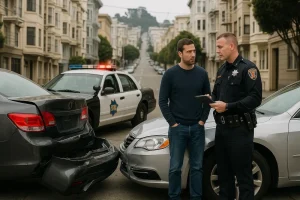
After a serious crash in Las Vegas, responding officers document the scene and often note their observations about how the collision happened. A police report is not the final word on liability, but insurers and attorneys give it significant weight. It may include statements from drivers and witnesses, diagrams, citations issued, and the officer’s assessment of contributing factors.
Physical and Digital Evidence
Skid marks, vehicle damage patterns, debris location, and the final resting positions of the cars all help reconstruct what happened. Photographs and video are powerful. Traffic and business surveillance cameras are common around Las Vegas, and dashcam footage can settle disputes about who had the right of way.
Witnesses and Expert Analysis
Independent witnesses who saw the crash can be persuasive because they have no stake in the outcome. In complex or high-value cases, accident reconstruction experts may analyze the data to calculate speeds, angles, and timing. Cell phone records can also reveal whether a driver was distracted.
Traffic Law Violations
When a driver violates a Nevada traffic law, such as speeding, failing to yield, or driving under the influence, that violation is strong evidence of negligence. Establishing a clear rule violation that led to the crash helps prove the other driver was at fault.
Nevada’s Comparative Negligence Rule Explained
Nevada uses a modified comparative negligence rule, which means your compensation is reduced by your percentage of fault, and you recover nothing if you are found more than 50 percent responsible.
Here is how it works in practice. Suppose your total damages are 100,000 dollars, and a jury decides you were 20 percent at fault for the crash while the other driver was 80 percent at fault. Your recovery would be reduced by your 20 percent share, leaving you with 80,000 dollars.
The critical threshold is the 51 percent bar. If you are found to be 51 percent or more at fault, you are barred from recovering anything from the other driver under Nevada law. At exactly 50 percent or less, you can still recover, though your award is reduced by your share.
Because of this rule, insurance companies have a strong incentive to shift as much blame onto you as possible. Even a modest increase in your assigned percentage of fault directly reduces what they must pay, and pushing you over the 51 percent line eliminates their liability entirely. This is one reason careful documentation and legal guidance can make a real difference in the outcome of a Nevada claim.
Nevada Car Insurance Requirements
Nevada law requires every driver to carry minimum liability insurance to pay for harm they cause to others. As of current Nevada requirements, drivers must carry at least 25,000 dollars for bodily injury or death of one person, 50,000 dollars for bodily injury or death of two or more people per accident, and 20,000 dollars for property damage. This is often written as 25/50/20.
Liability coverage pays for the other party’s losses when you are at fault. It does not pay for your own injuries. That is where additional coverage becomes important.
Why Uninsured and Underinsured Motorist Coverage Matters
Many drivers on Nevada roads carry only the minimum coverage, and some carry none at all despite the legal requirement. If an at-fault driver has no insurance or too little to cover your injuries, you can be left with bills the other policy cannot pay.
Uninsured and underinsured motorist coverage (UM/UIM) protects you in exactly those situations. It steps in to cover your losses when the responsible driver cannot. Given how quickly medical costs add up after a serious collision, carrying meaningful UM/UIM coverage is one of the smartest protections a Las Vegas driver can have. Insurers must offer it, though you may decline it in writing.
Options for Recovering Compensation After an Accident
After a Nevada crash, you generally have a few paths to compensation, and they can overlap depending on the facts.
File a Claim With the At-Fault Driver’s Insurer
The most common route is a third-party claim against the at-fault driver’s liability insurance. You submit your medical records, proof of lost wages, repair estimates, and other documentation, and you negotiate a settlement. Most Nevada car accident claims resolve this way without a lawsuit.
Use Your Own Coverage
If the at-fault driver is uninsured or underinsured, you may turn to your own UM/UIM coverage. You might also use optional medical payments coverage to help with early bills while the larger claim is pending.
File a Personal Injury Lawsuit
When an insurer refuses to offer fair value or disputes liability, filing a lawsuit may be necessary. In Nevada, the general deadline to file a personal injury lawsuit is two years from the date of the injury. Missing that deadline usually means losing your right to sue, so it is important to track it carefully.
Damages You May Recover
Compensation in an at-fault claim can include past and future medical expenses, lost income and reduced earning capacity, property damage, and pain and suffering. In cases involving especially reckless conduct, additional damages may be available.
When to Contact a Las Vegas Car Accident Attorney
It is worth talking to an attorney whenever fault is disputed, your injuries are serious, or an insurer is pressuring you to settle quickly. A lawyer can protect your right to full recovery when the stakes are high.
A local attorney helps in concrete ways. They gather and preserve evidence before it disappears, handle communications with insurers who may try to minimize your claim, and build the proof needed to establish fault under Nevada law. They also understand how comparative negligence arguments are used against injured people and how to push back on inflated fault percentages.
Phoong Law is a trusted local resource for people navigating car accident claims in Las Vegas and across Nevada. Having someone who knows Nevada’s at-fault rules and local courts on your side can relieve a great deal of stress while you focus on recovering.
If you have questions about a recent crash, you can reach Phoong Law at 866-GOT-PAIN for a free consultation to learn where you stand.
Frequently Asked Questions
Is Nevada a no-fault state for car accidents?
No. Nevada is an at-fault state, which means the driver who caused the crash is responsible for paying the damages, typically through their liability insurance. Nevada does not require personal injury protection the way no-fault states do.
What happens if I was partly at fault for a Nevada crash?
Under Nevada’s modified comparative negligence rule, your compensation is reduced by your percentage of fault. If you are found more than 50 percent at fault, you cannot recover from the other driver.
How long do I have to file a car accident lawsuit in Nevada?
The general deadline to file a personal injury lawsuit in Nevada is two years from the date of the injury. Missing this deadline usually bars your claim, so it is wise to act well before it expires.
What is the minimum car insurance required in Nevada?
Nevada requires at least 25,000 dollars per person and 50,000 dollars per accident for bodily injury, plus 20,000 dollars for property damage, commonly written as 25/50/20. Uninsured and underinsured motorist coverage is offered and strongly recommended.
The information in this article is for general educational purposes only and is not legal advice. Every case is different. Contact us for a free consultation about your specific situation.

















 English
  Español de México